September is the month of restart for many companies, and moreover the perfect time for rescheduling activities. But what should you do if you have a slow start, and you are not travelling with the desired speed? You definitely need to identify the problem, and deal with it in order to get the activities moving at the right speed. Every company has a vulnerable point, that is compared to a weak ring of a chain, and according to the theory of constraints there is the idea that a chain cannot be stronger than its weak ring. Therefore, the essential task of every entrepreneur is to identify and manage the most critical parts of its organisation.
 You have to focus on limits or constraints
The theory of constraints was developed by the Israeli business management guru – Eliyahu Goldratt, and introduced in the book “The goal” (1984). The book is based on the principle that the most important task of a company (and even of a non-profit) is to make a profit. Goldratt is considering each company as a system, or a chain of activities, and measured its success according to three parameters: inventory, the funds invested in the organisation, operating expenses, the funds used to convert inventory into sales, and the throughput, the cash coming flow. Every system has at least one “constraint” or weak link that, if it is identified and overpassed (or controlled, if it is unavoidable), will facilitate the accomplishment of the goals.
The key is to focus on the most significant limiting factor, as its management will produce the greatest benefit for the whole system. For example, by keeping the operational expenses low, may increase the efficiency of the department, but it is bringing benefits to the organisation only if it is also increasing the throughput. The five focus points are helping a company to bypass or to overpass the most significant constraints.
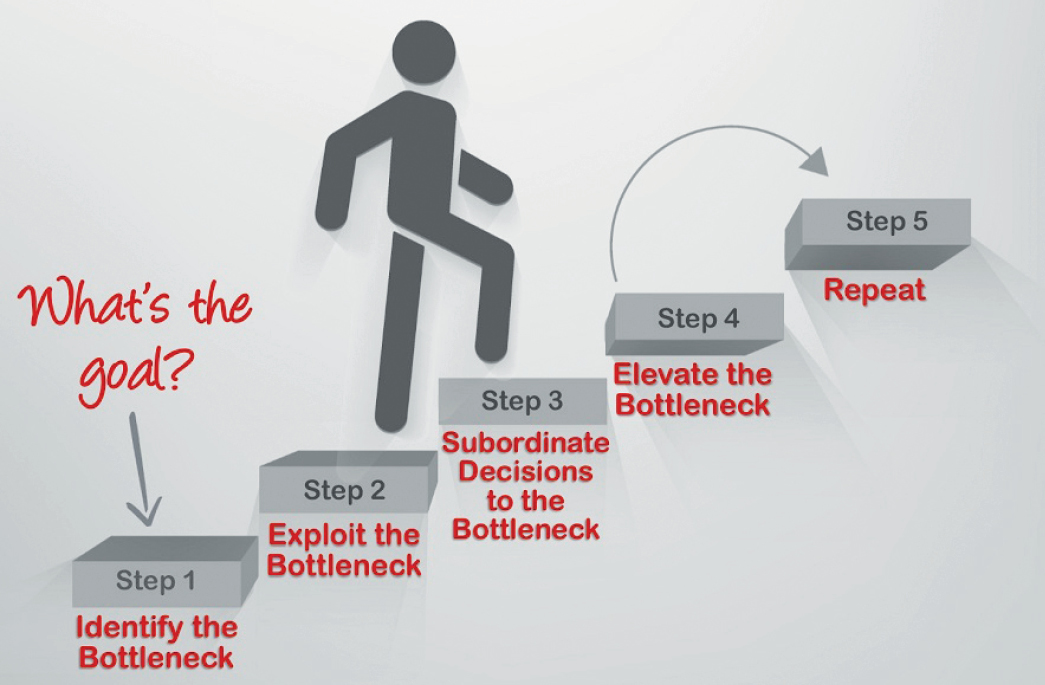
We take as example a company that is producing washing machines, that lost customers because of a high failure rate. How can we identify the problem and its resolution?
Through 5 steps:
1. IDENTIFY: you must establish first if is an internal or an external constraint, where it occurred in the system, and if it is involving resources, processes, personnel or policies.
2. EXPLOIT: implement the most efficient improvements with the available resources – e.g., focusing on parts subjected to failure and then ask yourself five times why these failures occur and the frequency they occur.
3. SUBORDINATE: for a smooth workflow, you must subordinate some other parts of the system to the constraint – e.g., accumulate stocks to fulfill orders.
4. ELEVATE: reduce or eliminate the constraint – e.g., by repairing or replacing malfunctioning machinery, or studying how to simplify maintenance, also in this case an effective Problem Solving could help.
5. REPEAT THE PROCESS: identify the next most significant constraint and repeat steps 1-4 to reduce or eliminate it. Repeat the process.
 Goldratt’s theory of constraints considers bottlenecks important, as they are the key to productivity. By identifying and managing the weak element, a manager can improve production significantly. On the contrary, by resolving an issue that is not a constraint, it can divert resources to the wrong area, worsening the situation. It is crucial to understand where the bottleneck is located within the production chain. It could be upstream, where the flow is normal, but trying to solve the problem at this stage could worsen the situation. For example: by increasing the production capacity could create a backlog in the bottleneck. Or, the constraint could be located downstream, where efficiency is reduced because there is not enough workflow.
However, making changes at this stage (e.g., increasing capacity) will not solve the problem. In the context of a business restart, Goldratt’s theory of constraints is a valuable tool for facing challenges and optimising operations. Identifying and overcoming bottlenecks helps to guarantee that the company runs at full capacity, increasing productivity and profit. By using this approach, the managers can drive the restart towards a successful future, where each facet of the organisation contributes to an unique and powerful production chain. •
di by
ALESSANDRO MARTEMUCCI
Lean Marketing Manager
OFFICINAE LEAN & DIGITAL MARKETING
Via Passarelli 99, Matera (I) – Tel. +39 0835 333321
info@officinae.com www.officinae.com
DETERGO Magazine # September 2023