Washing wool garments requires special precautions. Wool can be washed by hand in water (or wet cleaning) at temperatures not exceeding 35°C, using mild soaps and minimizing mechanical stirring; otherwise, the wool will felt (the garment will compact and reduce its size in both dimensions). This shrinkage, known as “felting,” is irreversible.


When wool fibres or animal hair are immersed in water, they swell because they are highly hygro-scopic, increasing their volume and becoming softer; mechanical agitation in a humid environment causes the irreversible compaction of the fibres, known as felting or shrinkage.

as we can see in the foto, on the sides the surface of wool fibres and animal hairs is covered with scale-like flakes with their roots in the fiber and their loose ends ends; these scales bind together the various fibers during movement, forming an irreversible and increasingly compact tangle until they create a felt
Felting is caused by a humid environment and mechanical stirring; the water pH (whether neutral or alkaline) and the bath temperature are the main factors that are highly influencing this process.
original knit
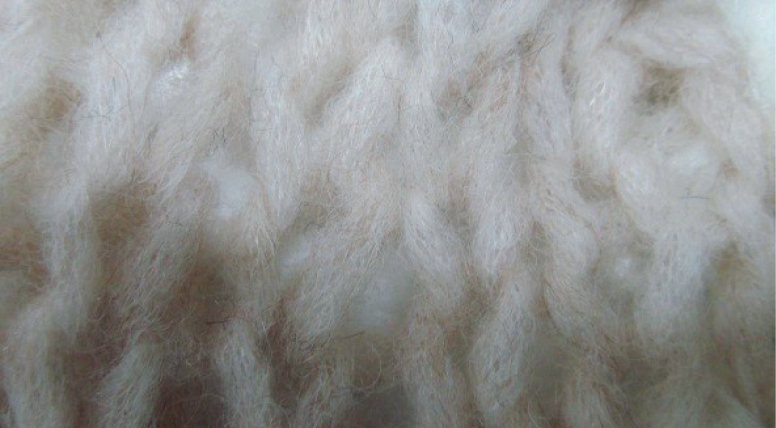

felted knit after being washed in the washing machine
The lower edge of the scales is tightly welded to the fibre, while the upper edge comes out to different degrees depending on the following parameters:
– temperature: as the temperature increases, the protrusion increases;
– water status: as the PH changes, the protrusion increases (therefore you need to use neutral soaps);
– distance between scale and flake;
– the shape of the flake if smooth or notched;
– the uniformity or irregularity in shape and distribution from root to top.
Under the same conditions (pH and temperature), felting will be different from fibre to fibre (wool quality) precisely due to the shape and positioning of the scales. It is therefore necessary to consider the type of material before defining the fulling or finishing method for knitted garments or cloths.
The shape and position of the scales are essential elements of qualitative recognition in the microscop-ic analysis between different types of wool and between wool and animal hair.
With the new regulations in force from December 2023, it has been introduced a new symbol for hand-washing: wash at room temperature. The old symbol allowed washing up to 40°C.
Wool, fading in fabrics that have undergone optical bleaching before

light exposure original
Optical brighteners are dyes with low colourfastness, especially to light.
Acetate-triacetate – viscose, stains from water droplets or sweaty hands

These are apparent stains caused by a different light refraction; such fibres absorb water and reflect light differently, giving the impression of a stain.
Perchloroethylene-alcohol, detachment of bonded and heatadhesive fabrics after dry-cleaning with perchloroethylene


bubbles caused by dry-cleaning; the fabric is internally bonded with a mesh
The combined action of perchloroethylene, the mechanical stirring, and the drying temperature causes the detachment of the heat-activated mesh, forming bubbles in the areas of detachment.
Rinsing after water washing can cause halos if it is not done quickly and abundantly

halos on quilt due to water stagnation
Cotton – linen – viscose – polyester, excessive shrinkage
cotton quilt (shrinkage caused the zipper curling)
shrinkage due to relaxation


polyester jacket water washed and dried on form finisher sleeve length before and after thermal shrinkage
Linen, severe fading caused by stain removers or pre-spotting treatments
 Linen has a low abrasion resistance due to the presence of woody fibres; friction causes the detachment of these superficial parts, causing colour loss and fading.
Cotton

Colour stains after a simple water washing (low colour fastness to tap water – colour changes towards pink or yellow; colours like light blue, beige, and colonial shades are more sensitive).
the oxygen released during washing removes the blue colour leaving pink/ yellow stains
Metals, potential failures during bleaching due to catalysis in the cellulose/hydrocellulose reaction

Viscose can suffer damages if not handled carefully when wet or if coming in contact with sharp metallic objects
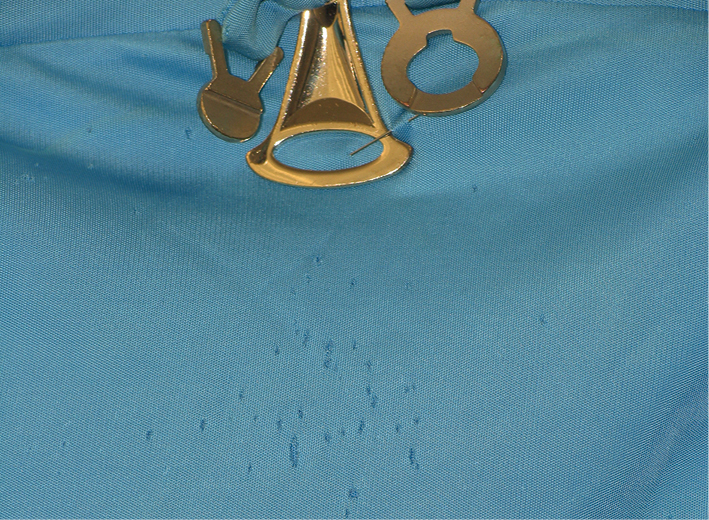
While cotton and linen are more resistant when wet than when dry, viscose reduces its resistance (already low when dry) by 50-60% when wet, so any sharp object (studs, buckles, etc.) can cause the formation of holes in the friction areas.
Pigment-printed fabrics, colour fading

In the case pf pigment printing, the bond between the printing paste and the textile substrate is physical (glue) and not chemical as in dye printing. Consequently, the colour fastness to rubbing is low, causing fading during water washing.
PVC fabrics and applications, are hardening if dry-cleaned

PVC is naturally rigid (see window frames, etc.), and to make it soft, phthalate is added. Phthalate is soluble in solvent, and as result, the item becomes rigid again.
Resinated and laminated fabrics: wrinkles, ripples, film detachment, stains, if dry-cleaned or after pre-spotting treatment with solvent-based products
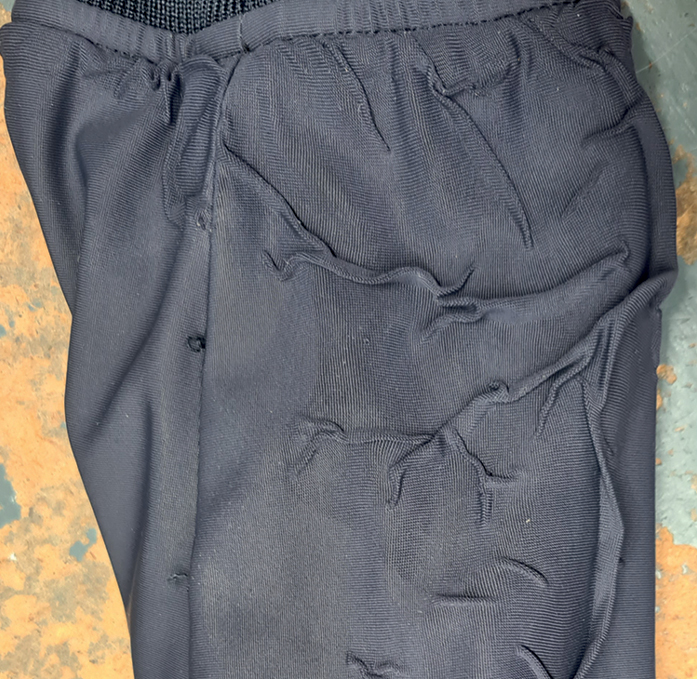
detachment of the outer fabric from the inner laminated fabric
The fabric is internally laminated with a synthetic film using adhesive resins. The combined action of the solvent and the drying temperature causes localized delamination due to the degradation of the adhesive, causing wrinkles. Additionally, if the garment is old, glue hydrolyses and loses its effectiveness (glues are also losing their adhesive properties during the time).
Faux leather dry-cleaned inserts

The inserts are made of an inner knit fabric laminated on the outside with a very thin film that imitates leather. The combined action of the solvent and the drying temperature causes the detachment of the outer film.
Dry-cleaned genuine leather hems
 Leather has low colour fastness to dry-cleaning with perchloroethylene; dry-cleaning with hydrocarbons improves colour fastness.
Elastomer spillage in dry-cleaning

Elastomer spillage becomes evident with washing as the elastomer initially coloured, loses its colour and turns white. The low coverage of the fibres around the elastomer core and its lack of thermal fixation makes the elastomer slip out of its casing, resulting in the alleged defect.
Dry-cleaned plastic accessories
Coloured plastic accessories (such as drawstring stoppers, buckles, buttons, etc.) can melt and stain the garment if exposed to hot solvents, especially if there is a colour contrast. •

LART Laboratorio Analisi e Ricerca Tessile Textile Research and Analysis Laboratory
Via Vasco de Gama 2 – 41012 Carpi (MO)
T. 059 645279
lart@lartessile.it – www.lartessile.it
di by ING. VITTORIO CIANCI
Direttore LART – Laboratorio Analisi e Ricerca Tessile
DETERGO Magazine # November 2024