We reach Alessandro Rolli, the Managing Director of Kannegiesser Italia, at the company headquarters based in Opera in the southern area of Milan. We start with a few observations on the just finished four-day Milan trade exhibition and the registered high visitor attendance. The dialogue then shifts to key concepts such as technology, sustainability and economic efficiency. We take this moment to discuss the current market evolution as well as technological innovations and how they could provide the right answers to the organizational needs of businesses today.
EXPOdetergo International 2022 finished a few weeks ago. What are your observations about those four days of the show?
First of all, let me say we were happily surprised by the knowledge of processes and technical competence expressed by many visitors to our booth. As a consequence, we, as suppliers, definitely needed to exhibit a higher competence level as well. It was extremely satisfying as the quality did derive from the request itself and it constituted an added value for us. The market has been facing some great transformations due to Covid as the latter favored the analysis of processes in a more detailed way, while the energy crisis brought an even further evaluation on machines’ efficiency. Our visitors appeared ready, informed and focused.
Did you exhibit any new, innovative machines during EXPOdetergo International 2022?
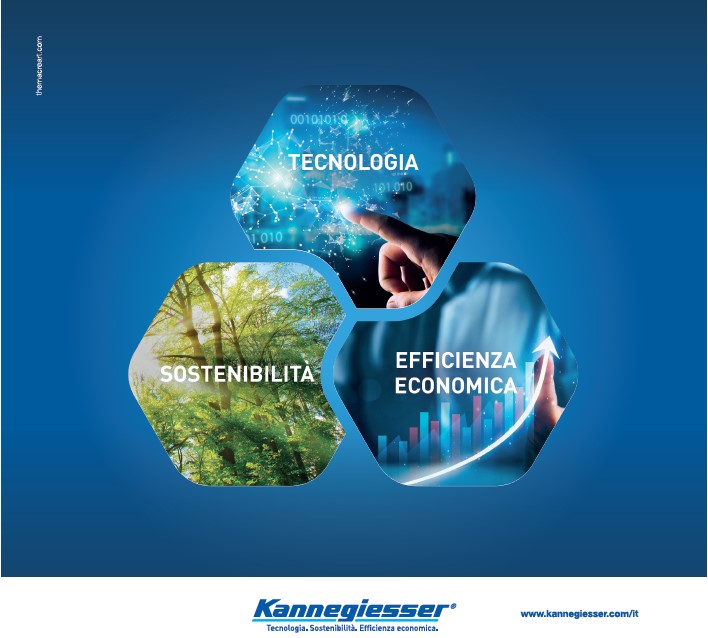
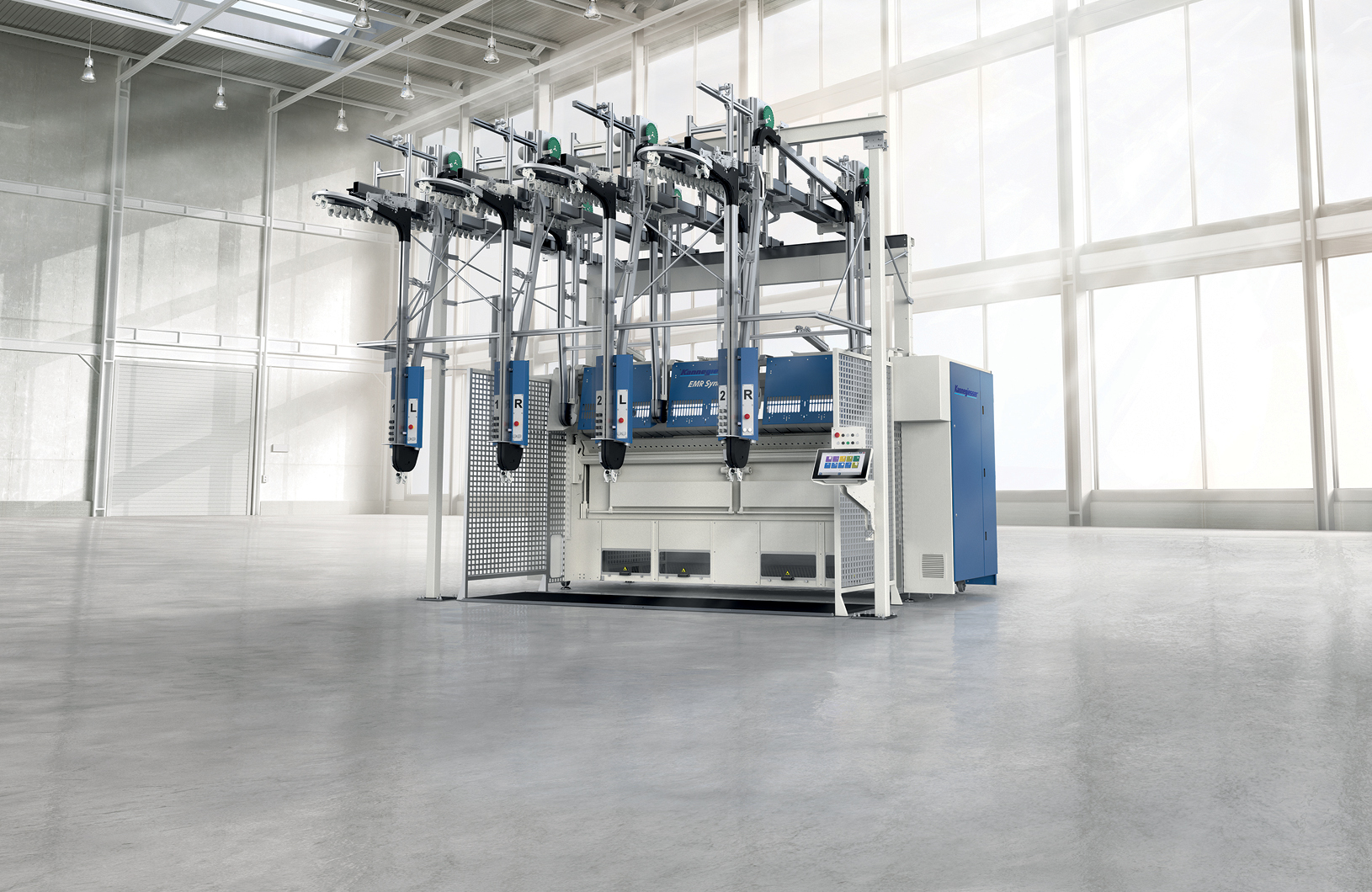
We focused on three concepts during this year’s edition of the show: technology, sustainability and economic efficiency. We really tried to solidify these three milestones of a productive process which reflected the real value of our market proposals. At our “Kannegiesser innovation fortress” (at the show) we exhibited a new, fully automatic folding system, a robot used for towels folding. We also presented a very innovative ironing line with the first feeding machine in the world that has been certified as fully ergonomic. We also focused on a dryer model that allows for an excellent recovery of hot air, so it represents a very low energy impact.
In addition, we exhibited our continuous batch washer PT VARIO, that, unfortunately, was not running during the exhibition due to the regulations imposed by the organizers. Our proposal in terms of product lines is changing quickly, I must admit. As a matter of fact, we used to focus on products. Today, we are considering entire systems. Let us take the tunnel washer as an example. It is not just equipped with the water recovery system anymore but, in many cases, we speak about an integrated heat exchange system or central systems of heat exchange (STS) that manage water and energy resources of more than one machine. What is more, it is possible to further increase water temperature through the use of other air/water exchangers (EMS). They can be installed with ironers, tunnel finishers and dryers. We have focused on a complete package, a platform, or better, a transverse technology. Today, Kannegiesser undoubtedly is the only laundry machines producer that can offer such solutions.
In the manufacturing of your “mega machines” you have always considered concepts like efficiency and effectiveness. What is the main point about them?
Let us start from the definitions. Efficiency shows the positive ratio between the input in terms of energy and the output in terms of results. Besides, the same concept reflects the processed pieces. Effectiveness, on the other hand, is strictly connected to the objective without really considering the way it has been reached. All the laundry businesses are pretty effective in terms of the objectives reached but they might not be efficient. There are indeed, parameters to measure the efficiency. When analyzing any business on regular basis, we will point out any possible critical points trying to improve the results in the consideration of operations. The challenge here is to transform an offer into a proposal that will contain value in terms of a significant return on the investment.

Over the recent years, you have strongly focused on and developed the concept of Ergonomics as a crucial element in the consideration of both “time” and “safety”. Time and what we do with it is absolutely fundamental in the development of productive processes. Has this been appreciated? How did the market welcome this innovation and the company philosophy applied to machines?
We have always tried to design work stations as best we could in consideration of the needs and the comfort of machine operators. The basic idea is that operators who make less effort will produce more and better, too. So, we design machines that actually are human friendly and make the work environment more adequate for operators.
A variety of concepts have been developed on ergonomics over the recent years. There is ergonomics linked to the machine itself and the operator’s posture but there also are cognitive and organizational ergonomic aspects. Machines convey signals that are captured by operators, therefore, the cognitive ergonomics is based on a multisensory approach. As far as organizational ergonomics goes, it is linked to the logistics of processes within a given area. It will focus on time and the most suitable collocation of the material to process.
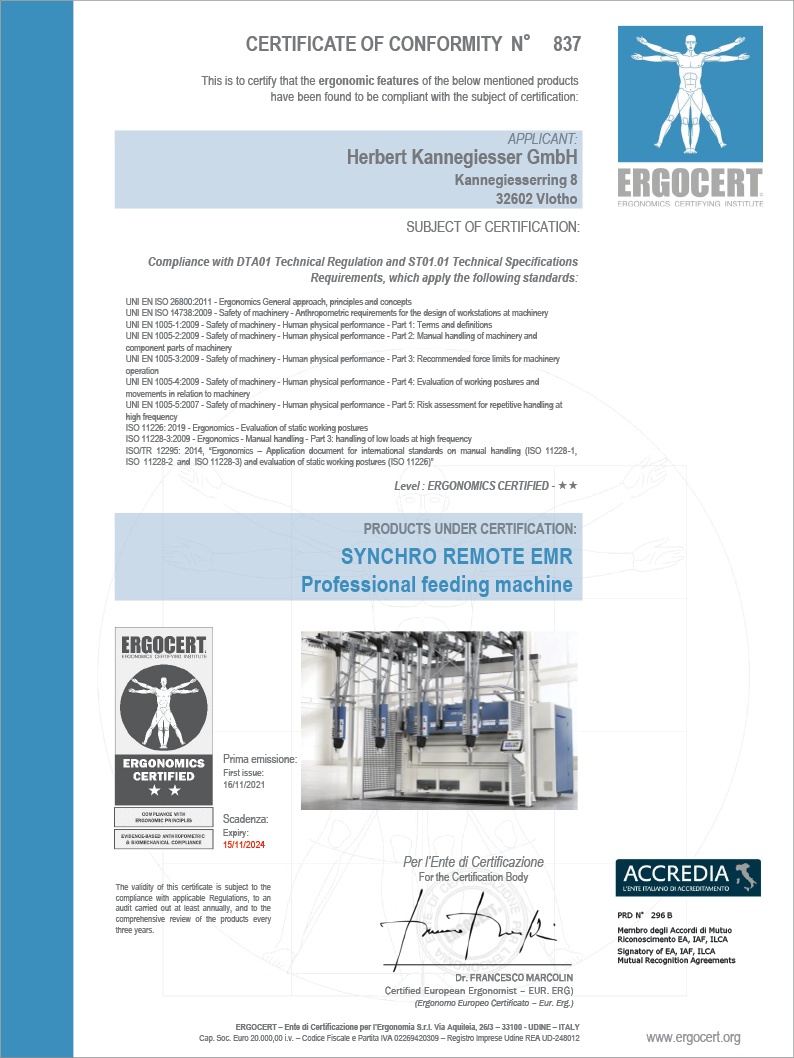
We had dedicated a lot of time to the topic of ergonomics and, in order to better understand its importance, we also organized a workshop about it followed by some other significant moments of analysis of this crucial concept. The course of research was concluded by the first feeding machine in the world obtaining the certification, our EMR – Remote Synchro feeder, fully designed following the ergonomic criteria. We wanted to measure its ergonomic parameters because, from the technical point of view, no evaluation on site had ever been executed in terms of benefits deriving from the interaction man/machine.
Tests were carried out while operators were wearing specific sensory suits and gloves that allowed us to define the workloads and postural movements that an operator will face during their working day. All that was measured using the Borg rating for perceived exertion scale, a method that defines efforts made during a particular operation. Testing was carried out over two days involving several machine operators, men and women of different height and under a variety of conditions. We then compared the traditional feeding system with ours, the more developed one, and we reached the conclusion, in brief, that we did obtain the benefit of 37% less in general effort made, according to the Borg method. The test was carried out in a scientific mode and it proved us right.

Therefore, “Ergocert”, a third-party institute released the certification for our machine. Going back to the initial question of this interview, we can say that customers have acquired a different kind of awareness also about ergonomics. It is also due to the fact that, in our sector, workforce is scarce as a resource and there is more and more sensitivity about the health and work conditions of operators. Considering our way, operators can produce safely, with fewer physical problems and feeling generally more motivated. We can also add a consistent reduction in injuries and in so-called work-related stress, which is then reflected in the reduction of absences from work. What is more, we had a comforting response from the EXPOdetergo International trade exhibition, and it proved that our direction has been the right one. Because it is a value-correct choice that translates into a cost-effective decision. The goal in the coming years will be to design, produce and market machines that meet the ergonomic requirements.

Over the last months, industrial laundries have truly been concerned about the rocketing energy costs. How can this issue be tackled from the saving point of view and how can the productive process be made more efficient?
The energy market is extremely volatile. Let us only think that the price of gas reached its highest level in August, while today (at the beginning of November), it has fallen consistently. From this point of view, it is complicated for an industrial laundry to change direction on the run. Our GAS machines can run either on Natural Gas or LPG by intervening slightly on the burner settings when necessary, so the customer can opt for one solution or the other.
The suggestion we can make concerns the source, that is, what exactly is the steam generation system used by industrial laundries? Today’s modern heat generators can also be hybrids or plan to be powered in different ways. These are complicated answers to provide. Right now, we are faced with a great deal of speculation, and whatever solution we may opt for may also turn out not to be entirely suitable six months from now. So, what we suggest is to focus on solutions aiming at the efficiency increase (so that less gas is consumed), and concentrate on machines that recover heat and energy. •

Kannegiesser Italia
Via del Lavoro, 14 – 20073 Opera Mi (Italy)
Tel.Ph: + 39 02 5760 6000
info@kannegiesser.it
www.kannegiesser.com