The crisis, as a consequence of the pandemic, has affected, over the last year or so, the entire tourism industry including textile businesses, hotels and restaurants, and this will definitely leave some permanent marks in terms of economics, social life and industries. The changes in progress are quite remarkable and it is not really possible to fully predict how they will affect the companies in question. Surely, one of the effects of the pandemic is forcing the industry to put to practice particular solutions in order to face the emergency.
Chemical businesses, including those operating in the chemical textile sector, reacted quickly. There have been numerous developments in relation to the anti-viral products that can be applied to various textile products.
 The velocity of responses proves that the industrial system, when faced with specific necessities, is able to react and change the offer, especially when it comes to the development of chemical products.
We cannot really tell how long exactly the requests will last, e.g. for the anti-viral products applied to industrial washing of bed linen or health care sector garments treatment. The technology is now available and it can be further developed and applied.
It is one of the side effects of the pandemic: the emergency involves changes, questioning oneself, evaluating new perspectives.
Companies can and will have to consider the possibility to innovate, to be “contaminated” by proposals and solutions applied to other sectors, to enlarge the perspectives and knowledge using a bit of imagination, too. It is not easy and there are no granted solutions but the future can bring unexpected developments. The ideas are there.
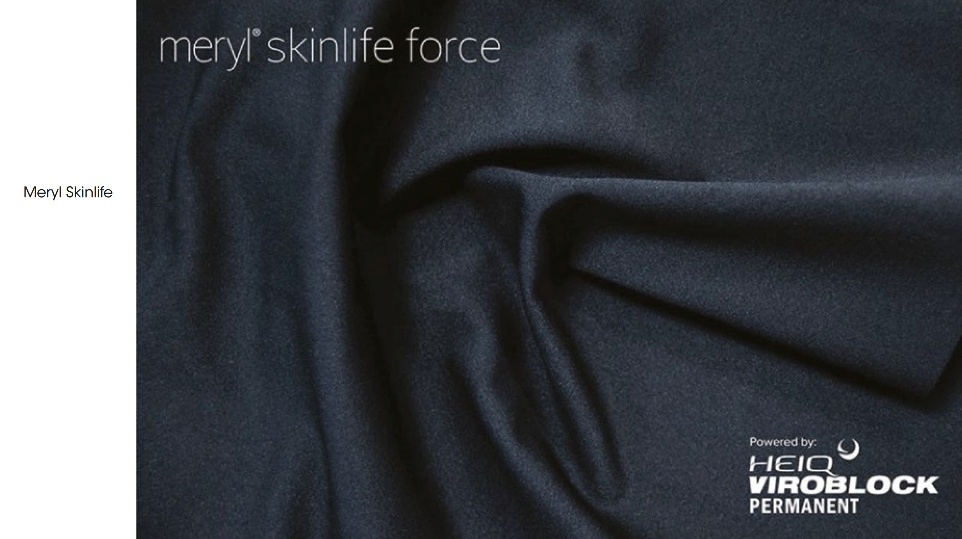 Today, we are dealing with synthetic fibers, such as the polyamide called Meryl Skinlife Force by Nylstar. The fibers are obtained through extrusion processes that allow to mix them with chemical additives making the fibers intrinsically anti-bacterial and anti-viral: these are basically permanent performances that won’t be affected by washing cycles, not even by industrial washing. In case of Mery Skinlife, the fiber is mixed with Viroblock Permanent by HeiQ. Textile producers could realize structures composed of a set of natural and synthetic yarns or of completely synthetic fibers, producing fabrics destined to, for instance, hospitals or hotels.
When we talk about the antibacterial and antiviral properties, the most common technique derives from the use of chemical products applied to fabrics through finishing processes. In this case, there are several issues to be considered in order to obtain optimal results. In particular, the effectiveness of the treatment is evaluated according to ISO 18184:2019 regulations “Determination of the antiviral activity of the textile products against specified viruses. Due to the individual sensitivities, the results of one test virus cannot be transposed to other viruses. The textile products include woven and knitted fabrics, fibers, yarns, etc.” As specified by the general description of the regulation, the obtained results that refer to a specific virus (for instance SARS CoV-2) cannot concern other viruses.
 A Swiss company, Sanitized AG, developed a patented product called Sanitized® T 99-19. It is based on quaternary ammonium silane compounds. The tests showed 99,84% of its antiviral effectiveness against SARS CoV-2 with the application of the product to polyester fabrics. It is always necessary to consider that the application conditions and the characteristics of a textile product can influence the overall performance of the treatment: still, the obtained results show an important contribution and efforts to contain the spread of the virus. The treatment can be carried out either during the finishing stage or during the further, washing stages by an industrial laundry: in this way, the efficiency can be renewed after every time the fabrics were used. What is more, Sanitized® T 99-19 has been certified by Oekotex Standard 100 class I.
There is quite a complex offer of chemical products today. One of the examples is reflected by the thermoregulating ability of XReflex, a product developed by Heiq. Their patented technology allows to form a radiant barrier, that when combined with the barrier constituted by the fabric, it enables to obtain good isolating performance. The technology uses the thermal radiation released by the skin and it reflects it towards the body instead of releasing it outwards. A particular deposition technique creates an ultra-thin layer on the surface of the fabric that allows to obtain, apart from the reflection of the heat released by the skin, the increase in the thermal resistance without alternating the air permeability of the fabrics. The technology can be applied to bed covers for instance, in the treatment of bed cover feathers or the wadding as well as the fabrics on the outside of the cover. The treatment would also allow to reduce the quantity of the feathers or the thickness of the wadding inside the bed cover which would translate to a clear saving in materials.  Considering smaller quantities of the material, thanks to the XReflex treatment, the thermal performance of the manufacture remains intact and the comfort of use increases given the lower weight and volume of the bed cover. Lower product volumes would be advantageous in terms of washing processes allowing to treat a higher number of pieces at each washing cycle, and reducing the use of water needed to process every single bed cover. The duration of the treatment is generally indicated as 20 washing cycles: however, the effective duration needs to be established by specific tests.
Water repellent treatments are also very popular. Today, the request is to obtain products that are not based on the use of fluorocarbons (PFC). Thanks to the combined technology based on micro capsules working as water repellents, and to the chemical agents that allow for a link of the micro capsules with the fibers, Archroma that makes part of the Smartrepel® Hydro family, allows to obtain a water repellent effect combined with good breathability and the duration of at least 20 washing cycles. The chemical component connected to the fibers has led to the product diversification due to the fibers characteristics that compose the textile product: Smartrepel® Hydro CMD is specifically developed for cotton fabrics and cotton mixed fabrics, while Smartrepel® Hydro TS is destined for synthetic fibers garments. The absence of the degradation formations due to yellowing, the maintenance of softness and the reduction of pilling effects were obtained while treating the fabrics, in compliance with the standard parameters ZDHC MRSL and Oeko-Tex® in reference to the PFC presence.
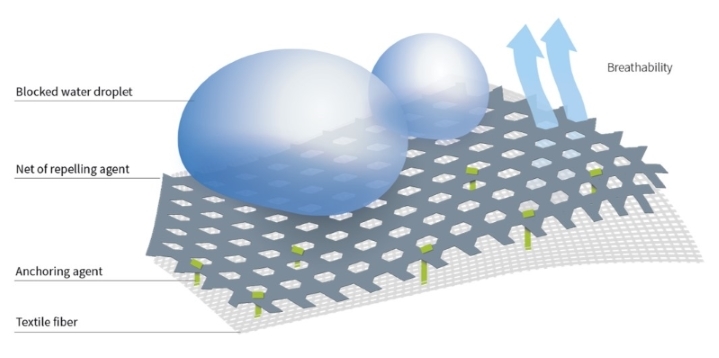 The most common application of water repellent treatments refers to sports garments such as windbreakers. It could be possible to extend its use to the personal protection equipment.
The most recently spread technology refers to graphene. An Italian company, Directa Plus, a leading European producer of graphene, obtained numerous patents in this field. Thanks to the production processes of physical nature, Directa Plus produces graphene that is lacking any chemical dangerous substances with a lateral micrometer dimension (axis X and Y) and the thickness (axis Z) of a nanometric dimension: this particular conformation of graphene G+® has allowed the company to obtain 27 certificates that attest the absence of any biological interaction.
The product called G+® Graphene Plus is a mixture based on nanoplatelets that can be applied to textiles in order to obtain properties that differentiate according to the construction of the textile material: from thermal conductivity, with heat dissipation and distribution, to the electric conductivity, with the dissipation of electrostatic charges, bacteriostatic properties, tribological effects, the reduction of surface friction, the breathability properties and waterproofing.
In the textile sector, graphene can be applied to sports garments, technical fabrics, personal protection equipment, shoes, house textiles. The application can be carried out either by print or the G+® Membranes.
 The above are only some of the new technologies that can be applied to textile surface to confer performances aiming at the solution of problems or meeting a variety of requests. They can also be applied to different production sectors, apart from the traditional ones.
The solutions presented above represent stimuli that enable us to look forward to the future, aware of the fact that every company constitutes a continuously evolving specific world that brings new opportunities every time. •
by Ezio Molinari
LT S.R.L.
Viale dell’Industria 42 – 21052 Busto Arsizio (VA) Italy
Tel. 0331 636078 e-mail: lt@ltsrl.eu