The laundry sector which has lately seen its plans, programmes and activities turned upside down, it is slowly getting out from this pandemic period. In this phase of hard work and recovery, for the entire sector fortunately, each one of us has a lot of activities on the track, that need to be developed and that may all seem urgent and important.
What would it happen if we would restart all these activities together? It would be certainly a remarkable commitment of financial and time resources, but the results may not be as expected, because we would not be able to follow all the activities in the same way, missing the most important and concentrating ourselves only on the urgent and daily ones.
We should also remember one important thing: that due to the COVID crisis, the financial resources of the companies are increasingly limited and therefore they need to be wisely invested and diverted towards what we believe that will give us a greater feedback on investment or business foresight.
Defining the business goals
In order to organise the company’s projects and activities for increasing the effectiveness and efficiency of our actions, we must first clearly define the goals that we want to achieve. The targets must respect the S.M.A.R.T. acronym: Specific, Measurable, Achievable, Realistic, Time-bound.
Taking advantage of the SMART criteria, the strategic objectives become clear and achievable, representing the most effective way to build intermediate milestones and concrete measurable metrics. Rather than setting a generic target like “increasing the number of Ho.Re.Ca. customers”, we could consider a SMARTer objective “the 4% increase in sales of the laundry sanitisation services in the Ho.Re.Ca. sector in the first quarter, compared to the last year”. The SMART objectives are the individual steps of a well- considered strategy oriented towards achieving wider goals.

Important vs. Urgent
The fundamental key to define objectively, in advance, is the difference between important and urgent. Eisenhower said: “What is important is rarely urgent, and what is urgent is rarely important”. If we can understand this difference, we will be able to easily prioritise the projects and the assets separating what is urgent or not, classifying the activities, including the daily tasks, according to their urgency and/or importance degree.
We must pay attention to the concept of being “important” that can often be subjective. But when we are talking about the corporate goals, the subjectivity is reduced. What might be important for one company may not be important for another one, and what it is important today may not be important in another moment. On the other hand, the concept of “urgent”, is objective and measurable, depending only on the time variable. Therefore, it should be applied to those activities that require immediate attention or at least with a very short deadline.
The Eisenhower Matrix is an useful tool for having an updated situation, every day under control, in order to define correctly the priorities, where by following the rules, we can place the activities, identifying possible waste and optimising time.
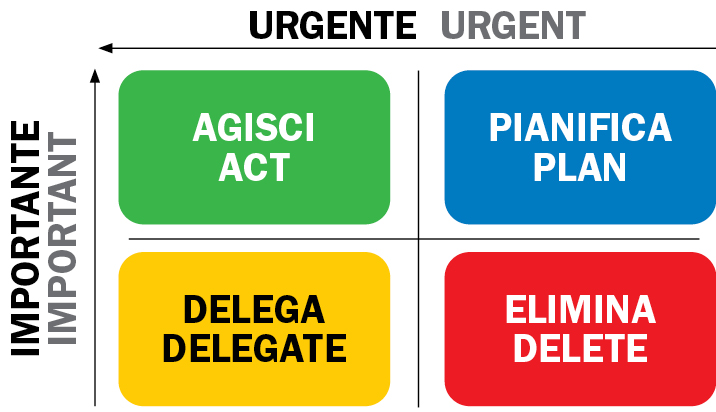
We can summarise the four coloured quadrants of the matrix:
• Green Quadrant = ACT: crisis – urgent and important
• Blue Quadrant = PLAN: important but not urgent
• Yellow Quadrant = DELEGATE: urgent but not important activity
• Red Quadrant = DELETE: waste – not important and not urgent
Let’s analyse each quadrant in detail
In the red quadrant we can find the tasks and the projects that need to be handled as soon as possible, and that cannot be delegated to the others (expiring projects, phone calls with the customers, pressing problems that need to be solved urgently, programmes that are due to expire or have already expired). In this quadrant we must find only few activities or projects, because a full quadrant is increasing the risk of errors, the loss of control regarding the situation, rising costs and forcing you to work in a constant stress and hurry, driven by the emergencies.
The Blue quadrant is related to the medium/long term planning, and therefore to the vision on the company’s future, which includes the implementation of the important but not urgent actions, new business opportunities and operational strategies that needs to be put in practice. Having activities and ideas in this quadrant means having a good future perspective. The projects of this quadrant are strategic and they have a long-term character, so that they can be faced without the pressure of urgency, but should not be postponed otherwise they will fall into the red quadrant.

The urgent but unimportant tasks return into the yellow quadrant associated with the delegation. These are activities and projects that are considered urgent and deceptively important, almost always dependent on external situations, and therefore delegable, here we find superfluous meetings, low value activities etc. This quadrant must be empty at all times otherwise the time spent in the yellow quadrant will only divert resources and energy away from the company towards activities that are not important. This quadrant must be always empty, otherwise the time spent in the yellow quadrant will only divert the company’s resources and energy to more important activities.
Finally, the red quadrant includes all the projects and activities that should be eliminated immediately. The trivial and superfluous activities, are not bringing any added value to the business, they are only generating a waste of time. A way to escape for those who are burdened by problems that we are usually afraid to face. It is therefore necessary to focus on the activities from the blue quadrant. Planning, even if the goal may seem far away, it allows the company to arrive prepared to the important appointments.

While we are focusing on the ACT or DELETE quadrants, we are running after emergencies, wasting our time and putting the very survival of the company at risk, in some cases.
How to fill in the Eisenhower matrix and how to set priorities?
We must first define a detailed list of projects and activities, identifying as accurately as possible the deadlines and the resources available to you.
Then, you must simply follow the 7 golden rules to set the priorities and that’s it!
1. Define the objectives
2. Define the tasks
3. List them regarding the importance order
4. Order them according to the emergency degree
5. Set priorities
6. Calculate the time needed per activity
7. Decide when to start (NOW!)
Enjoy your programming! •
by MARKETING&CUSTOMER
Alessandro Martemucci,
Marketing Consultant
Officinae Marketing Management