ENVIRONMENTAL DAMAGE
The synthetic fibres, especially those in polyester, are:
– considered to be among the biggest sources of environmental pollution;
– preferred by the disposable fashion for cost and performance reasons, a high percentage of polyester garments being produced by the low-cost brands;
– 35% of microplastic pollution in our seas is caused by washing and recycling production of synthetic fabrics, especially those in polyester.

Damages resulting from the use and maintenance of polyester garments
Polyester yarns can be classified in: continuous yarns and discontinuous twisted fibre yarns

 Continuous yarn Discontinuous yarn
The yarn is a combination of discontinuous fibres with a limited length of few mm (e.g., cotton) and up to 10-15 cm (e.g., mohair and wool-cut synthetic fibres) twisted together, while the thread is a bundle of seamless filaments with an unlimited length that can measure several hundreds of metres.
The continuous polyester yarns are divided into: smooth yarns and texturized yarns.


Smooth yarn Texturized yarn

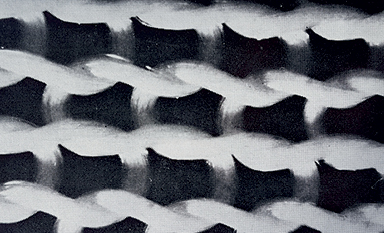
Smooth yarn Texturized yarn
Texturization is the process that modifies the geometrical positioning of the filaments by composing the centreline of a yarn, and causing it elastic or volume variations. The texturization is a textile process that confers specific characteristics to the continuous yarns. It can modify the texture, conferring thickness, elasticity or structural modification to the yarns. The new fashion tendencies are highlighting a high demand for the texturized yarns due to the new properties they offer to the fabrics requested by the consumers (lightness, higher comfort, elasticity, shrink-resistance, woollen or cotton appearance and texture, etc.).
Nowadays, around 60-70% of the worldwide production of synthetic continuous yarns are used as textured yarns. The application sectors for this category of yarns are in continuous expansion in the knitwear, traditional clothing and sportswear sectors. For this kind of garments, the snagging has become one of the most important frequent defects, contested by the manufacturers, the users and by the laundries.
The development of new yarns with always more reduced fineness (like the microfibres), is a fashion trend that requires soft and light garments with open structures (all with negative feedback regarding the snagging resistance) requires a special attention to the snagging resistance quite unknown to both endusers and laundries, even if the consequences of a low resistance to snagging, during wearing and during maintenance, are often the cause of major defects with consequent economic damages.
What is the snagging?
The snagging term defines the resistance of a fabric, made from continuous or mixed filaments and yarns, to the rubbing stress when the garment is worn and to the mechanical friction during the washing, that can change the fabric’s appearance for:


Formation of fibre clusters Interlacing distortion Loosen threads formation
or threads spilling out
from the fabric
In the case of the continuous yarn fabrics, the rubbing stress against the flat surfaces, with another fabric or against surfaces that are not perfectly smooth, cannot cause the fibres spillage, but they can cause the partial or the total breakage of the thread filaments, which, escaping from the fabric, they break forming little balls that are looking like a pill; as the cotton balls that are forming on the women’s tights when wearing them.
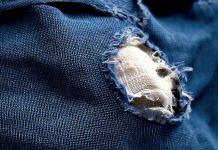
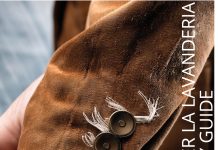
Some examples of defects related to the reduced snagging resistance, highlighted in washing:


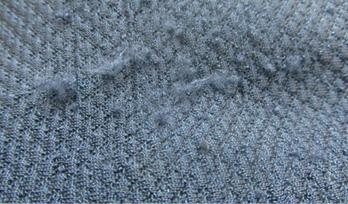
The snagging is measured according to the ASTM D 3939 standard with an instrument shown in the image below, called snagging tester. Some fabric samples are being cut in the warp direction (or thread) and in the weft direction (or ranks) with pre-determined measurements through a suitable gauge, sewn in a tubular form and then inserted, one at a time, on a felt-covered cylinder that is rotating in a clockwise direction. While the tube threaded on the cylinder is rotating, a spiked ball called “mace” is randomly bouncing along the tube causing various types of snagging: filament breaks, loosen threads, deformations, etc. The snagging degree is visually assessed through the comparison with the standard samples. The rating scale ranges from 1 (very poor) to 5 (very good).
Some tests examples and their evaluation


Snagging tester Evaluation 2/3 Evaluation 2
The resistance to snagging depends on various factors like the type of the texturized yarn: – fibres fineness
– the number of filaments
– twisting
– type of stitch or weave
– coefficient of friction
– fabric thickness
– bulkiness
– type of finishing
– surface


Parallel texturised Twisted texturised Interlaced
We can see in the illustrations above some types of textured yarns, those with parallel fibres and interlaced type are the most critical ones. •
di by ING. VITTORIO CIANCI
Director LART – Textile Research and Analysis Laboratory
LART
Laboratorio Analisi e Ricerca Tessile
Textile Research and Analysis Laboratory
Via Vasco de Gama 2 41012 CARPI (MO)
Tel. 059 645279
lart@lartessile.it – www.lartessile.it
DETERGO Magazine # February 2023