 Do you have problems with machines or products that you use at your laundry? Would you like to make things clearer on future possible technological development in dry-cleaning and manufacturing sector? Do you need to check issues such as laws, regulations and procedures? Knowing how many questions you deal with while at work, Detergo dedicates this new and useful tool, “The Technician Answers” column to its readers. In every issue Gualtiero Beretta, one of the most wanted repairing technicians and consultants in the world of dry-cleaning for years will cope with every question thanks to his skills, analytical competences and reliability. You can consult him by sending your e-mails to tecnico@berettagualtiero.it
Good morning,
I would like to ask for information relative to the presence of dark pink decalite inside my dry cleaning filters and in the distillation powder residue, etc. (before, the powder extracted was really dark grey). A very strange fact happened to me recently: after having distillated and prepared the filter (as usual) with the tonsil NFF powder and after about a 30-minute tank-filter-tank filtration that resulted in obtaining pure and non-color solvent, I washed white garments (shirts, jackets and trousers). All the garments were rigorously white when I put them inside, which means there was no other color in there, but after a complete washing and drying cycle, I withdrew pink garments from the machine!
Have you heard about similar cases? Could you tell me what does this fact depend on? Thank you in advance.
Antonio Prencipe
 Dear Mr. Prencipe,
the problem you are describing is common and widespread. Powder filtration (either decalite or celite) represents many advantages comparing to just one filtration through ecological filter discs. It allows to absorb grease and colorants. Let me explain better, in an ecological filter, the filtration is purely mechanical so the only substances that are possibly detained are solid particles and anyhow, bigger that the filter weft itself. While in a powder filter it is powder that is responsible for filtration. It captures grease and colorant substances. For this reason, it is crucial to adopt a “continuous distillation” washing system if you use ecological filters in order to keep away the grease and possible colorants (that quickly melt in the first wash) coming from the washed garments and drain the first polluted wash in the distillator. Such a system is applicable also to machines provided with powder filters as long as there are no contraindications. Often, however, old machines (with powder filters) were not pre-set for the continuous distillation washing or it was preferable to apply periodical distillation to better benefit from the filtration quality of the filters. Nevertheless, the application of periodical distillation makes the filters’ work more difficult as they have to detain all the grease and solid substances as well as the colorants left from the garments washing.
 Recently, garments have been generally presenting a high dyeing defect level. The colorants that have not been fixed correctly tend to be released in big quantities into the washing, which causes the toning of solvents. Powder filters absorb them by keeping the dye pigments in. When it comes to filters cleaning, the powder, which is full of detained substances, is then drained into the distillator. At the end of the distillation process, as the substances settle, they will have a variable color depending on how much they absorbed earlier: grey color if they detained grease and solid substances, pink/red or blueish if they detained great amount of colorant pigments.
 We can therefore deduce that if the decalite residue looks pink, the solvent in use in the distillator was full of colorants and it already had that typical “reddish” look. I would recommend carrying out more frequent periodic distillation in order to avoid the phenomenon that prevents garments from being washed correctly given the “reddish” solvent presence. The repositioning of pigments still present in the washing onto the garments is possible, especially on cotton made parts (e.g. white lining of trousers).
A powder filter defect consists of allowing a minimum passage through the filter for the powder used for fixing the filter, especially when the filtering weft is worn out. So, if the polyester fibers are worn out or damaged, a certain quantity of powder can pass through the filtering surface and stay in the wash suspension. Such a defect will gradually cause big powder quantities deposit in the tank. The deposited powder on the bottom of the tank works as if it was a sponge and it absorbs color pigments and grease substances from the solvent when the tank is dirty. It then releases them when the tank is filled up with clean solvent (in this case solvents work as if in an osmotic system therefore, similar substances move depending on their concentration degree: from the solvent to the powder if the solvent is polluted, from the powder to the solvent when the solvent is clean).
 Coming back to your specific case, what probably happened was that inside your machine tank there was quite a big quantity of powder that have caused the above problem. I would recommend that you dismantle the filter in order to verify whether the filtering weft is still complete and if need be, replace it. I would suggest that you should dismantle the tank hatch and clean the bottom of it very carefully.
Moreover, I would also carry out the analysis of solvent acidity level in order to check that its PH has not become too low (8 is the advisable value) because low acidity could cause an aggressive reaction of the solvent towards colorants and increase their release in the wash.
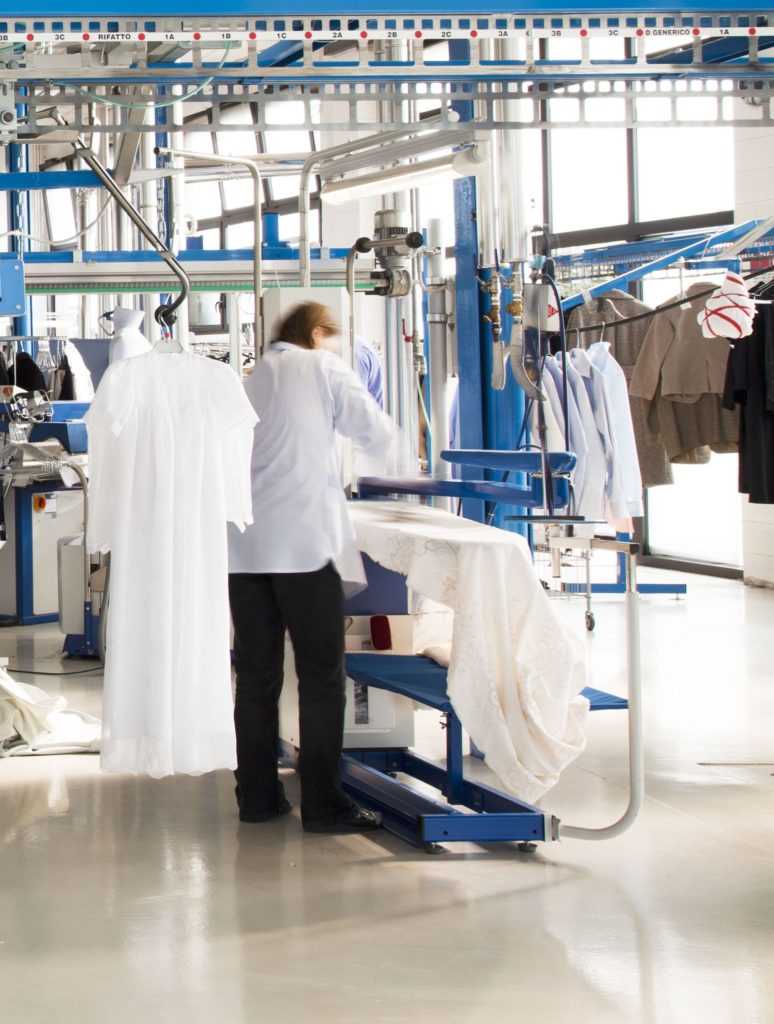 Gualtiero Beretta started to work as a maintenance technician in the sector of laundry machines in 1989 at DONINI International customer care office and gained his experience while working for the main Italian machine manufacturers. Specialized in preventive maintenance, in mechanical maintenance of bearings and rolling elements, qualified, and in the possession of the certificate for refrigerating system maintenance, Beretta has acquired great working experience together with broad technical scientific knowledge through hard work and his passion for it. He publishes important information relative to the operators of the sector on his updated website www.berettagualtiero.it
DETERGO MAGAZINE
JUNE 2016