The viral pandemic that arrived so suddenly from the Far East has changed our habits, the pace of life, old certainties and forced us to review our priorities as well. Who would ever think about having to sanitize rooms, goods, objects and products before the arrival of COVID-19? To take stock of the situation and to better understand sanitizing, we are speaking with Michele Battistella, a biological-chemical technical specialist and the Sales Manager at Battistella, a business based in Rossano Veneto (VI) that supplies ironing and sanitizing equipment. “We believe that facts speak for themselves even before the commercial catalogue. We have carried out a validated test on our 4 models of Atlantide (an ozone generator). As air samples are very difficult to examine, we chose to analyze the microbial evolution on surfaces inside a room (floor, table, desk, etc.) before and after the treatment with Atlantide. The results were surprising. The ozone produced by our generators had completely eliminated the bacterial load present in the room. The analysis was carried out by an accredited lab, N. 0157 L, following the ISO 18593:2018 method (par. 7 and 8 excluded) + UNI EN ISO 4833-1:2013”. The formulas and codes apart, the result is what matters most.” Battistella adds, “actually, nothing is more important than the current climate change, and the impact, negative or positive, that work or production processes have on our environment”.
 Lately, we have heard talking about ozone a lot. But how does it work exactly?
“Let us start from the basis, that is the pathogenic agents that ozone eliminates (viruses, bacteria but also bad smells, etc.). They all have something in common from the chemical point of view: the possibility of being neutralized all in the same way, through oxidation. Ozone is a molecule formed by 3 atoms of Oxygen and it is highly unstable. It is usually produced by a natural electric discharge (a lightning).
In our case, we use a special UV ray lamp. The oxygen molecule is naturally composed of 2 atoms and not 3, that is why it is highly unstable. Basically, the only aim of life of an ozone molecule is finding a way to discharge that extra molecule.
Here enters the harmful and pathogenic substance that, by combining with the extra oxygen atom, gets neutralized. In brief, the pathogenic substance that is in contact with ozone will give origins to oxygen and to a harmless substance. Such a reaction is called Oxidation.
As ozone is heavier than air, it can penetrate the fibers of textiles (mattresses, sofas, armchairs, rugs, carpets, the inside of a car, masks, uniforms, etc.). In this way, it reaches and neutralizes every microorganism and bad smells also when out of an easy reach, therefore impossible to be fully sanitized by classic cleaning procedures even if extremely thorough”.
After the technical, yet crucial explanation on an oxidation process, we are now going to focus on the range of sanitizing products by Battistella.
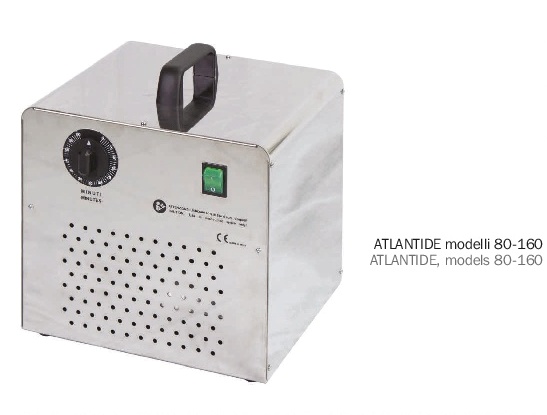
 ATLANTIDE, models 80-160
They are portable and manageable ozone generators fully made of inox steel.
The production system is based on an UV lamp and a powerful air vacuuming device to spread the ozone all over the entire room.
Atlantide 80 is suitable for the maximum of 80 cubic meters rooms in terms of size, while the bigger model called Atlantide 160, is ideal for rooms that are no bigger than 160 cubic meters.
At the end of the cycle, the room needs to be ventilated to allow the ozone to disperse in the air. It is also enough to wait for 30 minutes for the ozone to reconvert into oxygen.
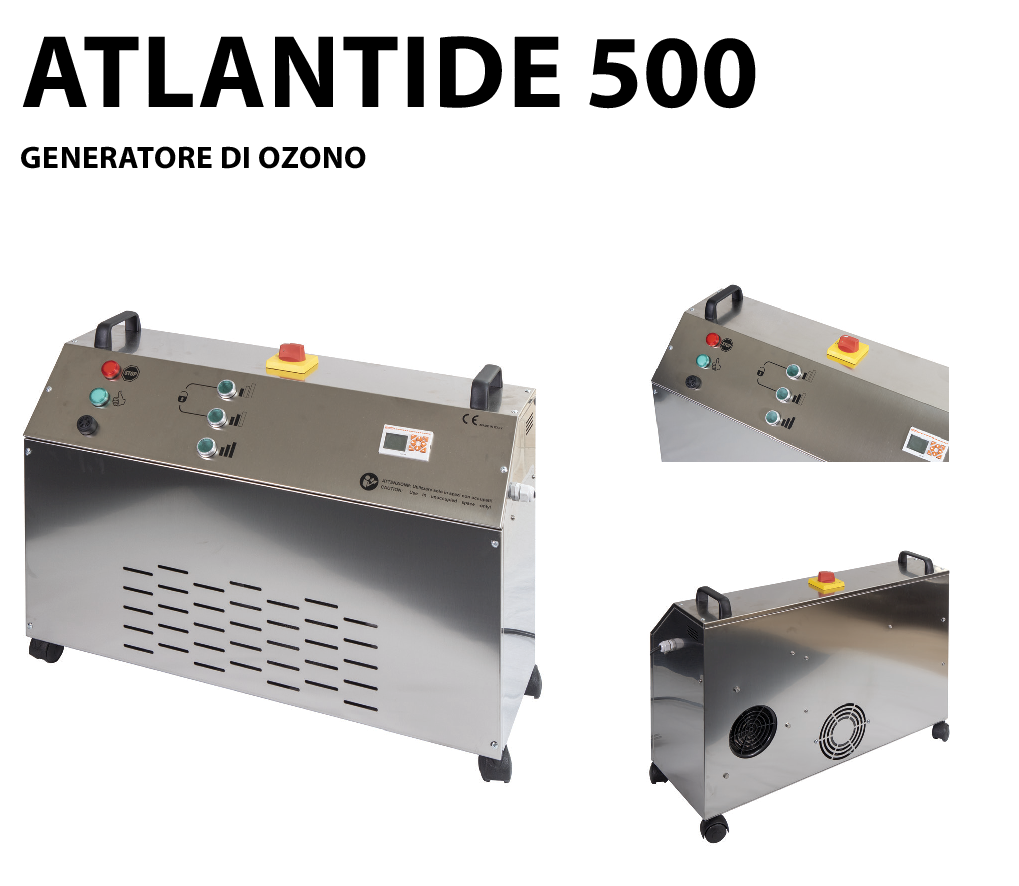
 ATLANTIDE, models 500-1000
Moving on to their industrial use, Atlantide 500-1000 models use the same technology as the smaller ones but with a greater power, necessary in an industrial environment.
The ozone production lamps are more powerful and the vacuuming engine pu shes the air to circulate into every corner of the room. At the end of the cycle, thanks to an active carbon filter, the ozone present in the room is destroyed.
It is possible to provide these two models with a timer and to program an automatic start at night. These are ideal models for 500 cubic meters and 1000 cubic meters rooms.
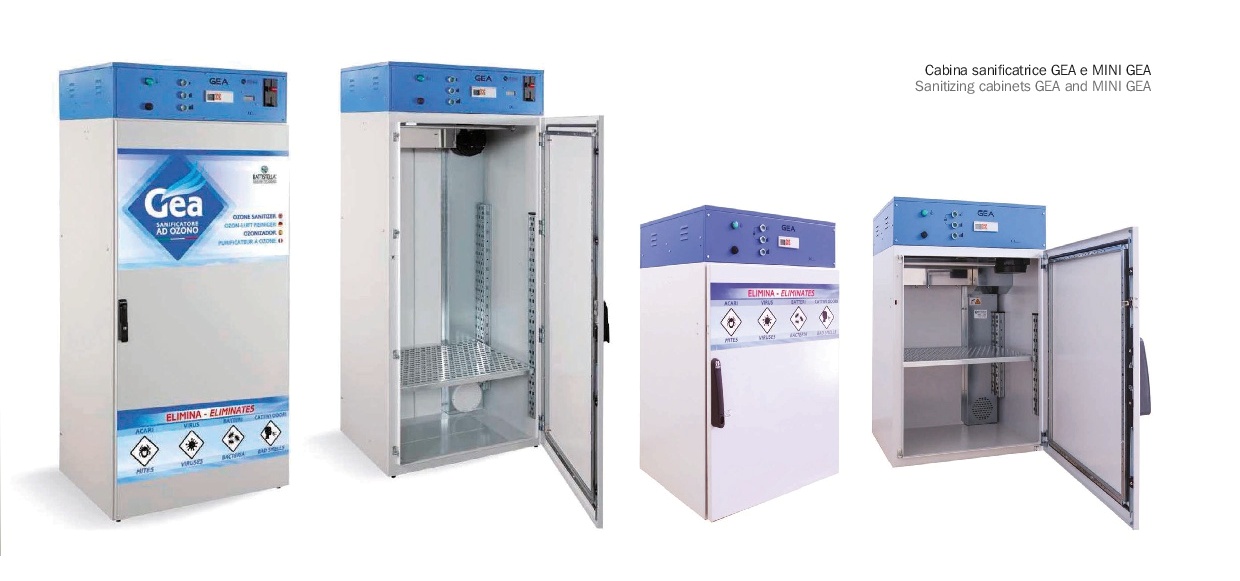
Sanitizing cabinets GEA and MINI GEA
The sanitizing cabinet GEA can be considered a real crown jewel of the sanitizing products range of the company. There also is a smaller version called MINI GEA for those who need a space saving solution. Let us list their characteristic features in order to better clarify the cabinets’ potential:
• The body of the machine is IP55 certified – so that ozone molecules do not leak out during the cycle.
• UV lamp production system is highly performing. The most powerful version of the machine reaches 39 ppm within few minutes.
• Long life-cycle of the lamps, more than 100.000 work cycles guaranteed (about 12-13 years of work performance).
• Ozone destruction is carried out by the second UV lamp which helps avoid the useless filter cleaning maintenance operations.
• Zero maintenance until the lamp change (12-13 years).
• Very low consumptions, only 143 W total.
The two versions of the cabinet are used to sanitize everyday objects and products, from motor cycling helmets to everyday use shoes, “lately, several nursing homes have purchased the cabinets to sanitize the wheelchairs of the residents” says Michele Battistella. The list of possible uses of the cabinet is quite long.
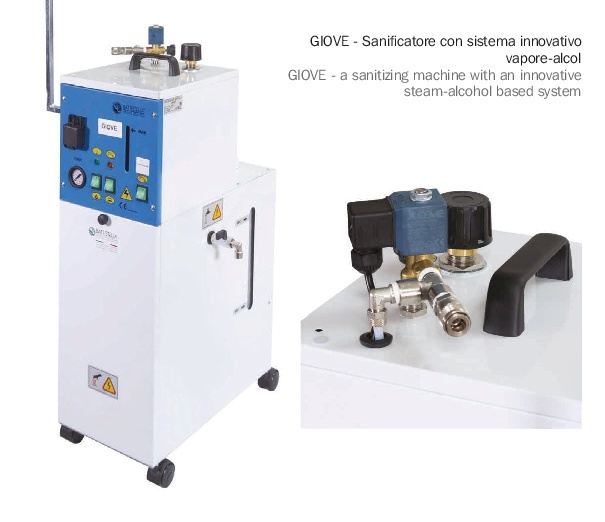 GIOVE – a sanitizing machine with an innovative steam-alcohol based system
Finally, let us focus on GIOVE that, speaking about certificates, has undergone the same accrediting test as the Atlantide. The sanitized sample was a cushion belonging to Lola, the Battistella family’s dog.
The cushion had been in contact with the dog daily, therefore it presented numerous microorganisms before the treatment. However, it was enough for the object to undergo a single treatment based on steam mixed with alcohol to completely destroy the entire microbe load and make it sanitized.
Giove uses an innovative system and it is equipped with a boiler made of inox steel entirely. It supplies steam at 4 BAR (about 150°C, the steam is mixed with an alcohol based solution).
The result is an extremely strong alcohol-based steam jet that leaves no room for viruses and bacteria. •
 BATTISTELLA B. G. S.R.L.
Via Bessica, 219 – 36028 Rossano Veneto (Vicenza) ITALY
Tel. +39/0424 549027 – 540476 – Fax +39/0424 549007
www.battistellag.it
info@battistellag.it
edited by Marzio Nava
Detergo Magazine June 2020